We Scanned 235 Product Pages. Almost Half of Them Can't Be Bought From by an AI Agent.
A study of 235 live product pages across 116 stores on Shopify, WooCommerce, Magento and BigCommerce. The median page scores 66 out of 100 for AI readiness, but 92% have no return policy an agent can read, 94% no readable shipping, and 47% have nothing an agent needs to complete a purchase.
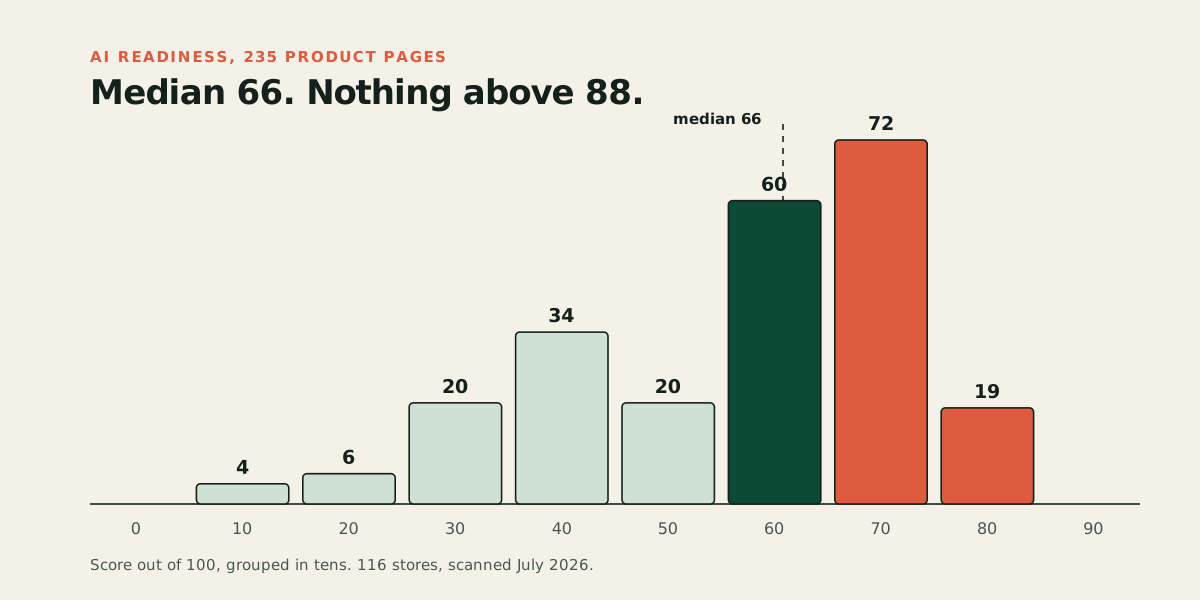
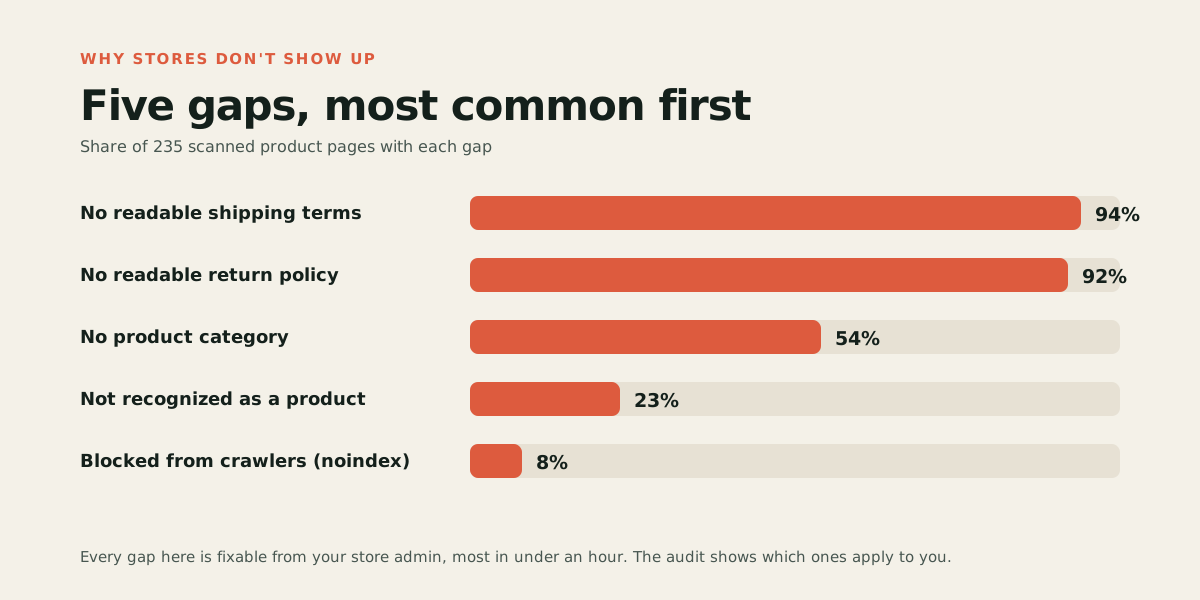
We scanned 235 live product pages across 116 stores on July 25, 2026, and scored each one on whether an AI shopping agent could reach it, read it, identify the product, trust the store, and complete a purchase. The median page scored 66 out of 100. That number sounds healthy until you look at what it's made of. Ninety-two percent of stores have no return policy an agent can read as data, 94 percent have no readable shipping terms, and 98 percent have no live connection an agent could query for the catalog. For 110 of the 235 pages, 47 percent, an agent has none of the three things it needs to complete a purchase. Stores are readable. Very few are buyable.
What we measured, and how
Each page was scored on the HTML that arrives, which is what four of the five major engines read. Vercel's study of AI crawler logs found they fetch JavaScript files without ever running them, with Gemini the exception because it rides Googlebot's rendering. We ran 32 checks grouped into five layers, weighted by how much each one shuts an agent out. Whether we could fetch the page at all carries 8 points. Whether the product is in the page that arrives, before any JavaScript runs, carries 36. Identifying the product carries 28, trust signals 18, and whether a purchase could actually be completed carries 10.
Checks that we could not run, or that do not apply to a kind of product, leave the total rather than counting against the store. A bottle is not penalized for having no clothing size. Every score below is out of the points that applied.
Our scanner announced itself honestly on every request and never impersonated a vendor's crawler. When a store turned us away, that is recorded as a finding rather than worked around.
What does the distribution look like?
| Measure | Value |
|---|---|
| Pages scored | 235 |
| Stores | 116 |
| Mean | 61.2 |
| Median | 66 |
| Range | 13 to 88 |
| Bottom quarter | Below 47 |
| Top quarter | 74 and above |
Seventy-two pages landed in the 70s and 19 in the 80s. None reached 90. At the other end, 4 pages scored below 20.
The middle is crowded, and the reason is that real stores are alike. They pass the same checks and they fail the same checks. A score saying most stores look similar is an accurate description of the web as it is.
For a store owner, that clustering is the opening. A page in the 70s is ahead of three quarters of the field, and the distance between the middle and the top is a handful of fixes rather than a rebuild.
Which signals do stores actually publish?
This is the heart of the study. The pattern is not that stores are missing information. It is that the information exists in the page text, written for a person, and is not published as data an agent can read.
| What an agent looks for | Stores where it is readable, of 235 |
|---|---|
| AI crawlers allowed in | 235 (100%) |
| The page loads without an error | 232 (99%) |
| Allowed in search results | 216 (92%) |
| Marked as a product at all | 182 (77%) |
| In stock or not | 176 (75%) |
| Price and currency | 171 (73%) |
| What kind of product this is | 144 (61%) |
| Ratings and reviews | 55 (23%) |
| A full product code, barcode included | 33 (14%) |
| A return policy | 14 (6%) |
| Shipping terms | 7 (3%) |
| A live line to the catalog | 0 |
Two rows deserve a second look. Not one page in 235 published a live endpoint an agent could query for the catalog, and four published a partial one. And the product code result is worse than the 14 percent suggests at first glance: 122 pages carried a partial identifier, usually a store's own SKU with no barcode, which is not enough for an agent to match your product against the same product sold elsewhere.
How many stores could an agent actually buy from?
One hundred and ten of the 235 pages, 47 percent, have no agent endpoint, no readable return policy and no readable shipping terms. In plain terms, an AI agent can't complete a purchase from any of them. Their median score is 60, against 66 overall, and only 2 of those 110 reach the top quarter.
That gap is the most useful thing here for a store owner. A page can score in the 60s or 70s, look fine, and still be a page no agent can transact with. The score is a relative measure of readiness against other stores. It isn't a statement that the checkout works for an agent, and we say that inside the report too.
What is quietly broken on live stores?
Three conditions cap a score because they stop an agent before the product data matters. The rates across 235 pages:
| Condition | Pages | Share |
|---|---|---|
| The page tells search engines to leave it out | 19 | 8.1% |
| No product information on the page at all | 9 | 3.8% |
| We could not read the page | 4 | 1.7% |
Nineteen live product pages carry a noindex instruction. Those stores almost certainly aren't doing it on purpose. It's usually left over from a staging setup or a plugin default, it keeps the page out of search results, and AI answers draw on those results. It takes a minute to fix once you know.
Nine more pages carry no product information an agent can read at all. A shopper sees a normal product page. An agent sees nothing it can use.
Does the product's category change the result?
Barely. Products we could not place in a category averaged 61.1, and products we could place averaged 61.2, so a missing category is not what separates a strong page from a weak one.
The real finding is coverage. One hundred and twenty-six of 235 products, 54 percent, could not be placed in a category at all, because placing one depends on the store declaring a category, and most don't. And not a single page in 235 published the details a shopper filters on within its category, things like size and size system for clothing, or model and specifications for electronics. Zero out of 235 is an open lane: this is information almost no store publishes as data yet.
What to do about it, in order
Start with anything that stops an agent before it reads your product. Check whether a live product page carries a noindex instruction, and whether your robots.txt turns away OAI-SearchBot, ClaudeBot, PerplexityBot or GPTBot. Then check that your product name, price and availability are in the page that arrives, not added later by JavaScript.
After that, the two cheapest wins in the whole study are shipping and returns, because 92 and 94 percent of stores have them written on the page already and simply have not published them as data. Then add a real product code, a barcode rather than only your own SKU, so an agent can match your product to the same product elsewhere.
Ninety-six of the pages we scanned ran on WooCommerce, and if that is your platform, we walk through each of these fixes step by step, none of which need a developer, in how to get your WooCommerce store into AI search.
For the full picture of how agents pick products in the first place, start with how to get your products recommended by AI. If you sell on Shopify, the platform sends your catalog to ChatGPT for you, but being listed is not the same as being chosen; how to get your Shopify products into ChatGPT Shopping covers the data work that decides ranking. And if your store is missing from AI answers entirely, these are the most common causes, with a self-check for each.
Almost nobody has done this yet. That is what makes it worth doing now: 92 percent of the field has no readable return policy and 94 percent has no readable shipping, so the fixes that take an afternoon are the ones your competitors have not made either.
You can check your own store in about a minute, on one product page, with the same 32 checks that produced these numbers. It is free and there is no account to create.