
Best AI Shopping Tools for Ecommerce (2026)
An honest guide to the AI shopping tools that help ecommerce stores show up and sell in ChatGPT, Perplexity, and Google's AI answers. We build one of them (Acom), so we say so, and rank by who each tool actually fits.
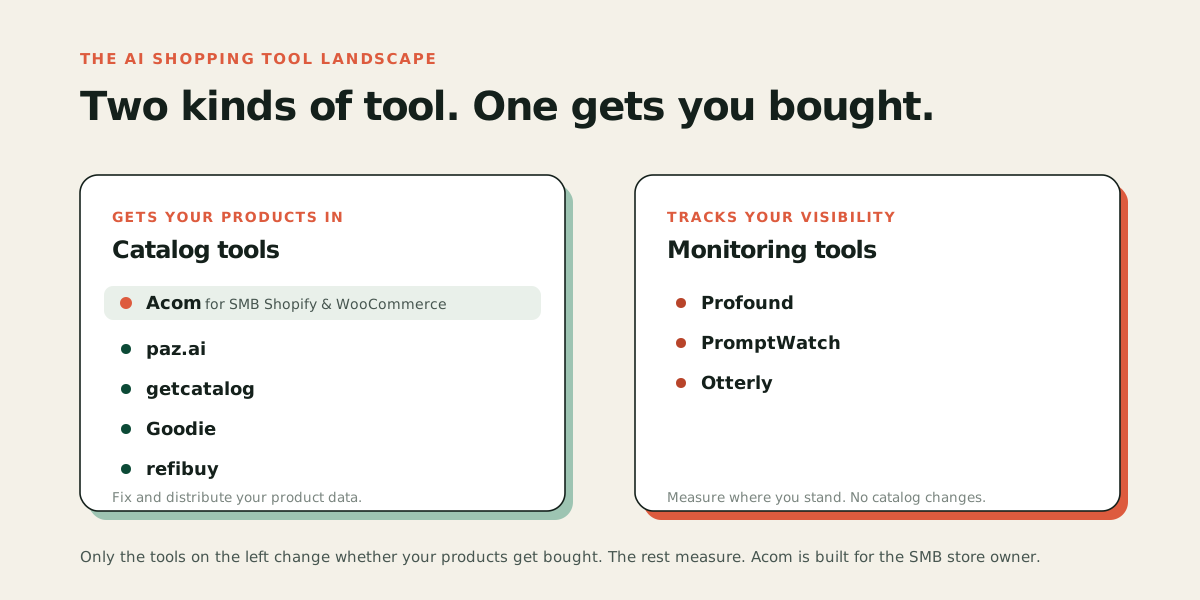
AI shopping tools help your products show up and sell when a shopper asks ChatGPT, Perplexity, or Google's AI what to buy. They fall into two camps: tools that get your products into AI shopping by fixing and distributing your catalog data, and tools that only track whether your brand appears in AI answers. This guide covers the main options and who each one actually fits. Full disclosure: we build Acom, one of the tools here. Every tool below gets a factual, first-hand assessment, and we rank for the reader this is written for: SMB and D2C brands on Shopify and WooCommerce.
What is an AI shopping tool?
An AI shopping tool is software that helps an ecommerce store get discovered, compared, and bought by AI shopping agents like ChatGPT, Perplexity, and Google's AI surfaces. The useful ones do one of two jobs, and it matters which.
The first kind works on your product data: it reads your catalog, fills the gaps an agent needs (category, identifiers, attributes, policies), and distributes that data into AI shopping channels through feeds and protocols. This is the kind that changes whether your products get recommended.
The second kind is a monitor: it tracks how often your brand appears in AI answers and what the assistants say about you. That is useful for measuring where you stand, but a monitor does not touch your catalog, so on its own it does not change the outcome. The clearest way to shop for a tool is to know which job you are buying.
How we chose, and how you should
We used facts from our own competitor research, verified against each tool's live pricing and product pages. We rank for a specific reader, the owner or marketer of an SMB or D2C ecommerce store, not for an enterprise retailer with a data team. The things that decide fit for that reader:
- Catalog or monitor. Does it change your product data, or only measure your visibility?
- Self-serve or sales-led. Can you start today, or do you need a demo and a contract?
- Platform support. Shopify is table stakes; WooCommerce is rarer than you would expect.
- Honesty. Does its scoring trace to real, checkable properties, or lean on invented benchmarks? All visibility numbers in this category are estimates, so how openly a tool says so matters.
- Price and friction. A free audit and a clear price beat a "book a demo" wall for an SMB store.
AI shopping tools at a glance
| Tool | Type | Best for | Platforms | Entry price |
|---|---|---|---|---|
| Acom | Gets products in | SMB Shopify & WooCommerce owners | Shopify, WooCommerce | Free, then from $199/mo |
| paz.ai | Gets products in | Mid-market, SMB-reachable | Shopify, CSV (more by tier) | From $149/mo, 14-day trial |
| getcatalog.ai | Gets products in | Mid-market and developers | Shopify, WooCommerce, Adobe, more | Sales-led |
| Goodie | Gets products in | Mid-market to enterprise | Shopify, BigCommerce, Amazon, more | $399/mo |
| refibuy.ai | Gets products in | Enterprise brands | PIM-based; Shopify coming | Sales-led |
| Profound | Tracks visibility | Enterprise | Monitoring only | From $99/mo |
| PromptWatch | Tracks visibility | SMB & agencies | Monitoring only | From $95/mo |
| Otterly | Tracks visibility | SMB & agencies | Monitoring only | From $29/mo |
1. Acom
Best for: SMB and D2C owners on Shopify or WooCommerce who want this handled without a sales call.
Acom is the AI shopping tool built specifically for SMB and D2C brands on Shopify and WooCommerce. It starts with a free AI readiness audit on a product page where every score traces to a real, checkable property of the page, with no invented benchmarks, then completes and distributes the product data that AI shopping agents read and buy from. Two things put it ahead for this audience: it covers WooCommerce, which most catalog tools skip, and an owner or marketer runs it without a sales call or a developer. It is the tool we would put in front of an SMB store first, and the free audit shows you exactly what to fix in about a minute. Start there.
2. paz.ai
Best for: stores that want a polished, catalog-native tool and can reach a little above SMB budget.
paz.ai is the closest comparable to Acom and the tool an Acom prospect is most likely to also evaluate. It is catalog-native and self-serve, with a three-part model that monitors your visibility, rewrites and enriches your product data, and distributes an optimized catalog to AI channels. Its scoring is honest and traces to real page properties, which we respect. It builds an optimized parallel catalog rather than changing your live store. Pricing has no free tier: a 14-day trial, then $149 a month (or $119 billed annually) for the Starter plan and $349 a month for Growth, the tier that adds distribution. Starter covers Shopify and CSV; more platforms come on higher tiers. It leans mid-market but an SMB store can reach it.
3. getcatalog.ai
Best for: mid-market stores and teams with developer help who want the broadest distribution.
getcatalog positions itself as the product data layer for AI commerce, and its strength is breadth: wide platform support including Shopify and WooCommerce, an API, and distribution to more AI surfaces than anyone else in this list, plus its own structured storefront. It has a genuine data-honesty posture, flagging low-confidence and unresolved fields rather than guessing. The catch for an SMB store is the go-to-market: pricing is usage-based or sales-led with no clear public plan, and much of it is aimed at developers and larger merchants. Powerful, but not the frictionless self-serve path an owner usually wants.
4. Goodie
Best for: mid-market to enterprise brands that want a full AEO suite with real commerce features.
Goodie is a full-stack answer-engine tool with a genuine SKU-level commerce suite: it tracks individual products across ChatGPT Shopping, Amazon Rufus, Perplexity, and Google AI Mode, ingests feeds from Shopify, BigCommerce, and others, and can remediate feeds and generate product copy. It is capable. It is also priced and packaged for larger teams: the self-serve plan is $399 a month, higher tiers are demo-gated, and its reporting leans on projected rather than checkable numbers, which is the opposite of what we optimize for. Strong if you are mid-market and want everything in one place; heavy for an SMB store.
5. refibuy.ai
Best for: enterprise brands and retailers, not SMBs.
refibuy coined the term "agentic commerce optimization" and is built for the enterprise end of the market, with a full evaluate, enrich, distribute, and monitor loop and customers among large brands. Two practical notes for this audience: its integrations are PIM-oriented and Shopify support is not live yet, and it is sales-led with no public pricing. Worth knowing as the enterprise reference point in the category, but the opposite of an SMB self-serve tool.
6. Profound
Best for: enterprise brands that want the most credible visibility measurement.
Profound is the category leader in AI brand visibility, and its data pedigree is the best here: it licenses conversations from real consumer panels rather than only generating synthetic prompts, which makes its numbers closer to real demand. But two things make it a poor fit for an SMB store. It measures brand visibility, not your catalog, so it tells you where you stand without changing it; and its shopping product is ChatGPT-only and enterprise-tier. Pricing runs from $99 a month up to enterprise. If you are a large brand that wants to measure the AI conversation, it is excellent. For getting an SMB store's products bought, it is the wrong shape.
7. PromptWatch
Best for: SMB stores and agencies that want to monitor AI shopping visibility affordably.
PromptWatch is a self-serve AI-search monitoring tool that does something most trackers do not: it captures real product cards from AI shopping answers, with price, merchant, rating, and position. Its prompts are grounded in Google data rather than pure guesswork, which makes them more defensible. It is monitoring, though, not catalog management: it shows you what is happening, it does not change your product data, and the product-card tracking sits on the $245 Professional tier (plans start at $95). A good measurement layer to pair with a catalog tool, not a replacement for one.
8. Otterly
Best for: SMB stores and agencies that want the cheapest way to start monitoring.
Otterly is the accessible entry point, from $29 a month, and it is a clean, self-serve way to monitor how your brand shows up in AI search. It even has a query fan-out simulator that shows how an engine expands a single prompt. But its unit is the brand and the cited page, not your catalog: it detects brand-level shopping cards, it does not structure or distribute your products, and it offers advice rather than doing the work. Fine as a low-cost way to watch your position; not a tool that changes whether your products get bought.
What about the general AI visibility trackers?
You will also find broader "AI visibility" or GEO tools such as Peec, Semrush's and Ahrefs's AI modules, and others. They are worth knowing, but they measure brand mentions across AI answers, not whether your products get bought. For an ecommerce store, they answer "is my brand talked about," which is a different question from "are my products structured and transactable." We left them off this list on purpose to keep it to tools that touch AI shopping.
Which AI shopping tool should you choose?
If you run an SMB or D2C store on Shopify or WooCommerce and want to set this up yourself, start with Acom; paz.ai is the other catalog-native option worth evaluating. Run a free audit and fix your gaps from there. If you are mid-market with a developer or a team, getcatalog and Goodie are worth a look for their breadth. If you are an enterprise brand, refibuy and Profound are built for you. And if all you want right now is to measure where you stand, PromptWatch and Otterly do that cheaply, just remember that measuring is not fixing.
Wherever you land, the honest first move costs nothing: run a free audit on one product page to see exactly what an AI agent can and cannot read about your product. Then, if you want those gaps fixed across your catalog rather than by hand, start a free trial and Acom does the work, with you approving everything before it goes live.