What Is Agentic Commerce? A Plain-English Guide for Shopify and WooCommerce Stores
Agentic commerce is shopping done by an AI agent on a shopper's behalf. Here is how it works in 2026, what Shopify and WooCommerce now do for you automatically, and why getting listed is the easy part.
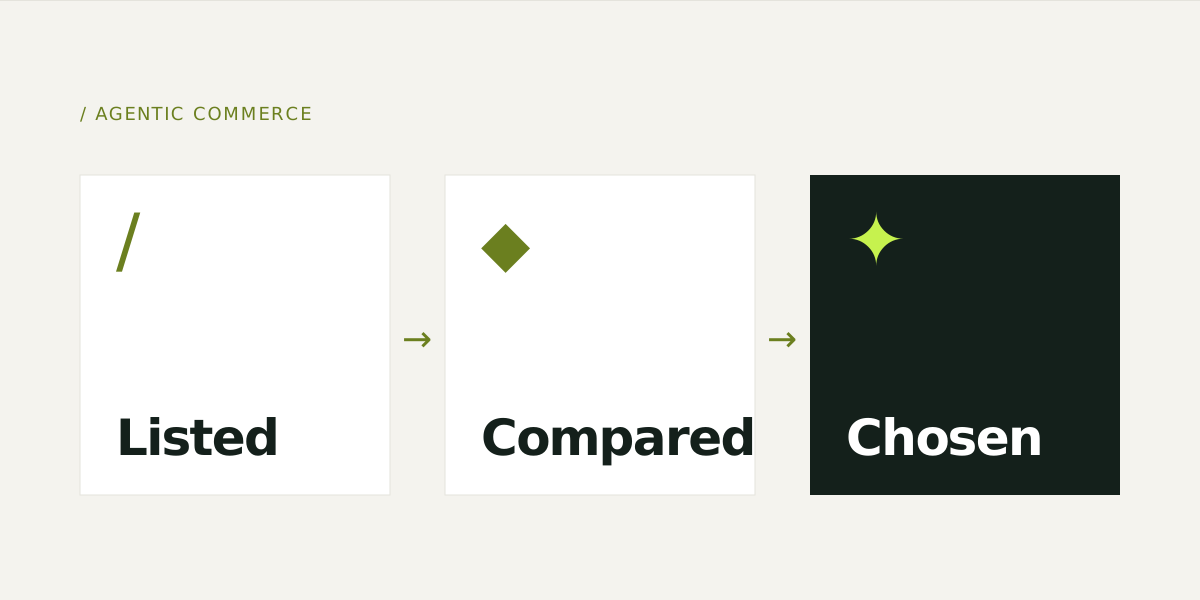
Agentic commerce is shopping done by an AI agent on a shopper's behalf. Instead of browsing stores, a shopper asks ChatGPT, Gemini, Copilot, or Perplexity to find and compare products, and the agent comes back with a short list. In 2026 the big platforms made it easy to get listed in those assistants. Shopify now sends eligible catalogs to ChatGPT by default. Getting picked is a different problem, and it comes down to the product data the agent can read. This guide explains how it works, what Shopify and WooCommerce do for you, and what is still on you.
What is agentic commerce?
Agentic commerce is any purchase where an AI agent does the shopping. The shopper says what they want, and the agent does the finding and comparing, then recommends a few products or sends the shopper straight to one.
"Agentic" just means the software acts on its own toward a goal instead of waiting for a person to click through each step. In shopping, the goal is a good match for what the shopper asked for.
This changes who you are selling to first. The agent does not see your photography or layout. It reads the data underneath: product name, price, stock, category, attributes like size and material, reviews, and your shipping and return terms. If that data is clear and complete, the agent can recommend you with confidence. If it is buried in images and loose copy, the agent picks a competitor it can read more easily.
How does buying through an AI agent work?
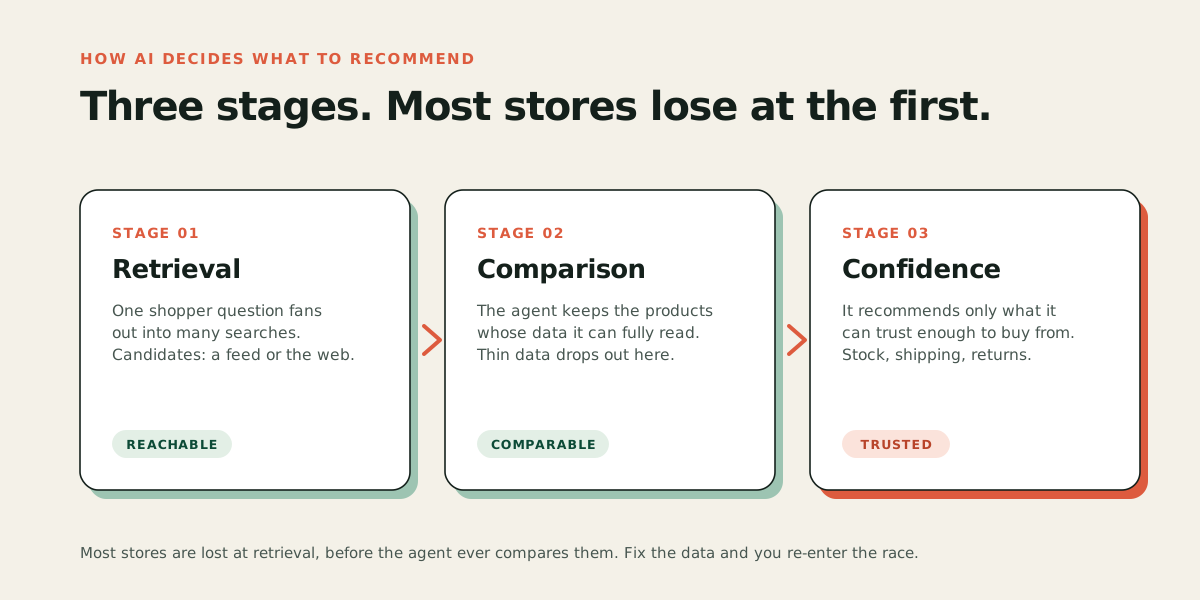
There are three stages, and a store can win or lose at each one.
First, retrieval. The agent turns the shopper's question into a set of candidate products. It pulls them from a catalog feed, like the one Shopify supplies, or from the open web, which it searches and reads on the spot. If you are not retrieved, nothing else matters.
Second, comparison. The agent lines up the candidates it can describe and checks them against what the shopper asked for: price, size, material, compatibility, delivery time, return window. Complete data wins here. A product described only in brand copy gives the agent nothing to compare.
Third, the handoff. The agent recommends a short list and the shopper clicks through to buy. OpenAI tried in-chat checkout in ChatGPT and scaled it back in March 2026, so today the sale finishes on your own checkout. For Shopify stores, that opens in an in-app browser on mobile and a new tab on desktop. The shopper lands on your product page already halfway to a decision. We cover the first two stages in more detail in how to get your products recommended by AI.
Is it big enough to matter yet?
The volume is still small next to search, but it is growing fast and the shoppers who come through it buy more readily than search visitors.
On its Q2 2026 earnings call in August, Shopify said AI-driven traffic and orders to its stores both tripled year over year. New buyers arrive through AI channels at nearly twice the rate of other channels, and AI search converts nearly 80 percent better than traditional organic search. Shopify was also clear that agentic volume is still small relative to its total sales. (Shopify Q2 2026 call)
Adobe's numbers across US retail point the same way. In July 2026, AI-referred traffic to retail sites was up 62 percent year over year, converted 60 percent better than other traffic, and brought in 53 percent more revenue per visit. (Adobe, via Digital Commerce 360) For this holiday season, November 1 to December 31, Adobe forecasts AI traffic to US retail sites up 130 percent, with the biggest jump on Thanksgiving. (Adobe forecast, September 2026)
Two details from Shopify matter most for smaller stores. Half of all AI-referred sessions land directly on a product page, so that page has to answer the shopper's question on its own. And 75 percent of AI-attributed orders in Q2 came from outside Shopify's top 100 product categories. Agents are sending real orders to niche products, which is where most specialist stores sell.
What does Shopify do for you?
Quite a lot of the plumbing. In March 2026 Shopify launched Agentic Storefronts. Eligible merchants' products are discoverable in ChatGPT by default, and Microsoft Copilot, AI Mode in Google Search, and the Gemini app are managed from the same section of the Shopify Admin. There is nothing to install. Shopify says there are no transaction fees for ChatGPT beyond standard processing, you stay the merchant of record, and orders show up in your admin tagged with the AI referral. (Shopify, March 2026)
Shopify also co-developed the Universal Commerce Protocol with Google, which is the standard Google's AI surfaces use to read catalogs and hand off purchases. Shopify merchants are covered by it without doing anything.
So on Shopify, being listed is mostly handled. What Shopify sends, though, is whatever is already in your product admin. A thin title, an empty material field, or a return policy that only exists as a paragraph on a separate page all go out to every AI channel exactly as they are. The details are in how to get your Shopify products into ChatGPT Shopping.
What about WooCommerce?
WooCommerce has no built-in equivalent of Shopify's automatic syndication. There is no switch in the admin that puts your catalog into ChatGPT, Copilot, and Gemini at once.
Most WooCommerce stores reach AI assistants in two ways. The first is the open web: agents read your product pages directly, the same way they read any site. The second is a product feed published through a third-party plugin, and several now exist for ChatGPT and other assistants, with mixed quality. WooCommerce also shipped an MCP integration as a developer preview, which lets an agent connect to store data directly, but that is still developer territory.
This puts WooCommerce stores in an odd spot. They have less done for them, but full control. The product page is usually the only thing an agent reads, so it has to carry everything: clean product markup, complete attributes, readable prices and stock, and shipping and return terms stated as data. The steps are in how to get your WooCommerce store into AI search.
Listed is not the same as chosen
Shopify's own president described the AI partnerships as opening "more front doors for commerce." That is the right way to see it. Shopify and the WooCommerce plugins open the door. The agent still has to pick you over every other store in the same feed, and it picks on the data it can read.
Shopify has numbers on this too. AI searches powered by its structured catalog converted at twice the rate of searches that relied on data scraped from web pages. Structured, complete product data does better than whatever an agent can piece together from a page on its own.
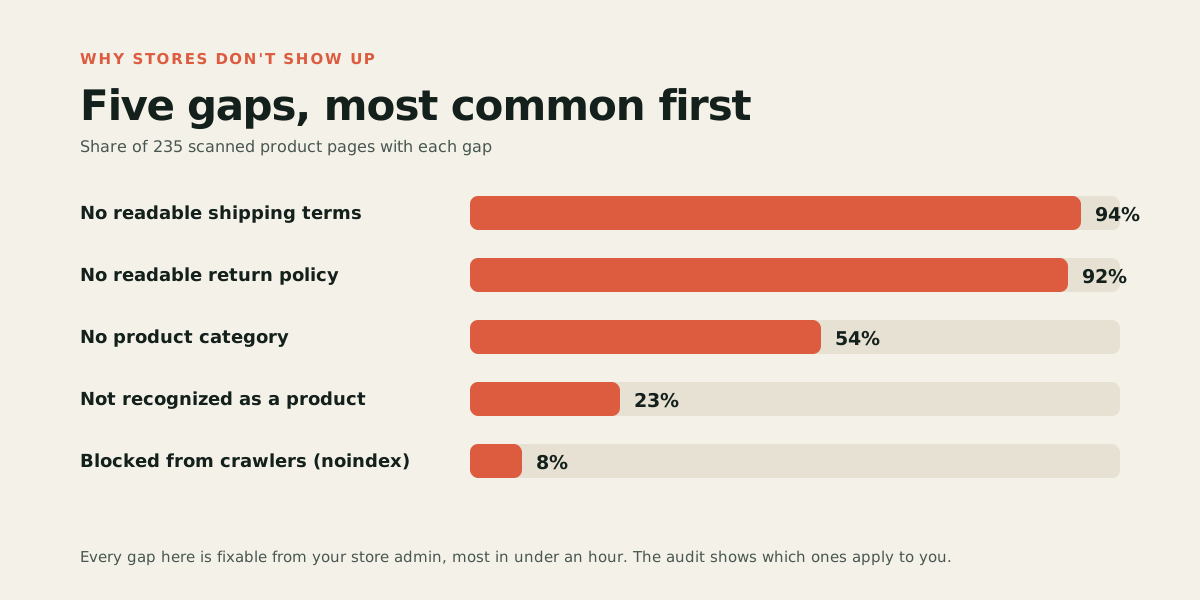
That is where most stores fall short. In our scan of 235 live product pages, 94 percent had no shipping terms an agent could read as data, and 92 percent had no readable return policy. These stores are not missing something advanced. They are missing the things a shopper asks about before buying: when will it arrive, and can I send it back.
The gaps we see most often on Shopify and WooCommerce stores:
- Product titles written for a person who already knows the brand, not for an agent matching a query.
- Empty attribute fields like material, dimensions, size, color, or compatibility, with the information buried in the description or in images.
- Shipping and return terms written as page text instead of structured data.
- Reviews that show on the page but are not in the product markup.
- On WooCommerce, AI crawlers blocked by a security plugin or a robots.txt rule nobody remembers adding.
Each of these is small on its own. Together they decide whether an agent can say your product fits, or has to move on to one it can describe.
What are ACP, UCP, and MCP?
These are the shared standards that let agents read catalogs and hand off purchases without a custom integration for every store. You will see the acronyms everywhere, but you will almost never implement them yourself.
| Protocol | Who is behind it | What it does, in plain terms |
|---|---|---|
| ACP (Agentic Commerce Protocol) | OpenAI, with Stripe | How products get listed in ChatGPT and how a purchase is handed to the merchant. |
| UCP (Universal Commerce Protocol) | Google, with Shopify | The equivalent for Google AI Mode and Gemini, now backed by a wider group including Microsoft and Stripe. |
| MCP (Model Context Protocol) | Anthropic | A general standard that lets an AI agent connect directly to a system's data and actions, including a store's catalog. |
Your platform, payment provider, or plugin handles these. They have one thing in common: all of them read structured product data. Whichever protocol wins, complete and machine-readable product data pays off.
Where Acom fits
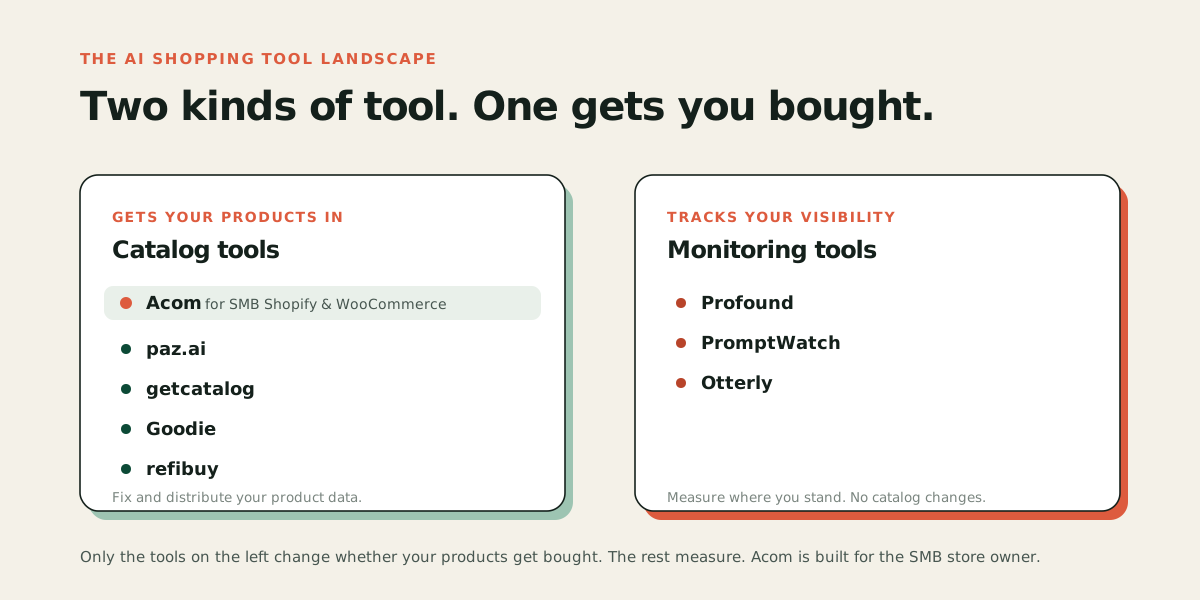
Shopify and WooCommerce get your products in front of the agents. Acom is built for the next step, making sure that once an agent reads your products, it can recommend them.
Run a free audit on one of your best product pages. It reads the page the way an agent does and shows exactly which gaps apply to your store, with no account or card. Most owners find that two or three fixes cover most of the distance.
When you would rather have those fixes made across your whole catalog than do them by hand, start a free trial. Acom connects to your Shopify or WooCommerce store, fills in the missing product data, and publishes shipping and returns as structured data. You see every change before and after, and nothing goes live until you approve it.